
Tailored for your success
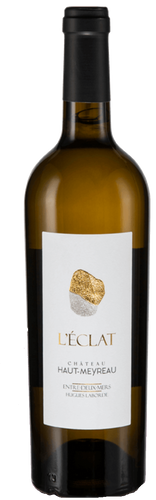
L'Eclat
Hugues Laborde - Entre deux mers
White,Entre deux mers
Sauvignon blanc, Sauvignon gris
history
Historic Bordeaux estate dating back to 1802, Château Haut Meyreau currently covers over 100 hectares in the Entre-Deux-Mers region. It serves as the foundation of our properties, both a model vineyard and a place of experimentation, where we have reintroduced polycultureprinciples in recent years.
Vineyard
Sourced primarily from 40-year-old vines in Naujan-et-Postiac, this cuvée takes root in exceptional asteriated-limestone terroirs of Entre-Deux-Mers. Cultivated with natural grass cover and harvested by hand in small crates in the morning, yields are naturally limited to 40 hl/ha. This distinct limestone geology allows Sauvignon Blanc and Sauvignon Gris to achieve full aromatic complexity and rich texture while preserving vital tension and a signature saline finish.
Winemaking
Pressing is done 100% with whole clusters, without sulfiting the harvest. The presence of the stems at this stage is essential for managing pH and contributing a bitterness that complements the wine's structural backbone. Cold settling with bio-protection yeasts is carried out for 8 hours. Clarification is therefore done earlier than in traditional process. Fermentation takes place in barrels (60% new, 40% one wine). We deliberately leave certain amount of lees in the must, as this provide a support for the indegenous yeasts and contains aromatic and structural compounds taht contribute to achieving a "vinous" profile rather than a "simple and fruity" one. Fermentation with indegenous yeasts lasts nearly 10 weeks. About 30% of the blend undergoes malolactic fermentation. After racking, this cuvée is aged about 10 months.
Tasting notes
The palate is broad with a smooth attack and a fresh, aline finish, all supported by a confident structure.
Food pairing
Gers chicken with morels, fresh tagliatelle
Aging potential
8 years
Grape varieties
Sauvignon blanc, Sauvignon gris
Cuvée France
32 Rue Robert Mallet Stevens
BAT C
30900 Nîmes - FRANCE
+33 (0)4.66.23.44.22
32 Rue Robert Mallet Stevens
BAT C
30900 Nîmes - FRANCE
+33 (0)4.66.23.44.22
GOVERNMENT WARNING : (1) According to the Surgeon General, women should not drink alcoholic beverages during pregnancy because of the risk of birth defects. (2) Consumption of alcoholic beverages impairs your ability to drive a car or operate machinery, and may cause health problems